
Top Things To Do In Cairo
Although most people travel to Egypt for the ever-enticing, Pyramids of Giza and Great Sphinx (and rightly so), there are many other interesting sites and things to do in Cairo.
In total, I spent over 5 weeks between Cairo, Luxor, Aswan, Abu Simbel, Alexandria, and Sharm El-Sheikh, seeing the archeological sights, exploring the cities, diving the Red Sea, and trying to gain insights into its ancient and current culture.
This post covers the top things to do in Cairo, as well as some logistics to help you plan your trip.
About Cairo
Cairo is the capital of Egypt, with Greater Cairo being the biggest city in Africa and one of the biggest in the world. Sometimes also called ‘The City of a 1,000 Minarets’, due to the large number of Islamic mosques, it’s both exotic and chaotic at the same time.
Car horns honk incessantly and store vendors track you down on the street to entice you into their shops, while the Islamic call to prayer seems to be forever echoing in the air. It’s a never ending torrent of people, sites, and sounds vying for your attention.
Top Things In Cairo
Of course, the pyramids and mysterious Great Sphinx are deservedly the top site, but also try to find time to explore some of Cairo’s more recent history. This includes the beautiful ancient mosques and tombs in UNESCO Islamic Cairo, the Orthodox churches in Coptic Cairo, the Roman fortress of Babylon, and more.
The Pyramids
There are three areas to see the best of the Pyramids and the Great Sphinx. Not only are they relatively close to each other, they’re also relatively close to Cairo. Click here for more details.

Ancient Pyramids
Built around in the 27th century BC, the very first pyramids were lessons towards their final form.
Saqqara, the royal necropolis of ancient Egypt, has what’s considered the first Egyptian pyramid. Built for Pharaoh Djoser of Dynasty III, it’s called the ‘Stepped Pyramid’.
In nearby Dahshur, you can see the first attempt at a smooth-sided pyramid, called the ‘Bent Pyramid’, and the first successful one, the ‘Red Pyramid’. Both built by pharaoh Sneferu, father of Khufu, who went on to built the famous Great Pyramid of Giza.


How To Get To The Ancient Pyramids: Saqqara and nearby Dhashur is about 20 miles (32 km) from Cairo. It’s best to visit via organized tour or taxi. Your hotel can help arrange this for you.
The Pyramids of Giza
The famous Pyramids of Giza, on the Giza Plateau, were built by successive pharaohs Khufu, Khafre, and Menkaure in the 26th century BC. Making them even more spectacular, they were once encased in smoothly-polished white limestone, which must have been dazzling in the brilliant desert sun.

The Great Pyramid of Giza, or Pyramid of Khufu, is the tallest and oldest of the three. It’s also the only wonder of the ancient world left standing.
Khafre’s pyramid stands in the middle and is the second largest. Although it appears largest, it’s just built on higher ground. Menkaure’s pyramid is the smallest, while the three shorter ones were for royal family members.
The Great Sphinx, whose mysteries are perpetually fascinating, is also located in on the Giza Plateau.

The sites here are nothing short of fascinating, and when you add in the fact that they’re almost 5,000 years old, and ponder the amazing feat of engineering it took to build them, they’re completely over the top.
How To Visit The Pyramids: The pyramids of Giza are only about 9 miles (15 km) from Cairo. In addition to an organized tour or taxi you can also take the metro from Cairo to Giza, then a minibus from there. Alternatively, you can stay in Giza and just walk to them. See my write up on the pyramids for more details.
Top Museums in Cairo
Central Cairo is where much of everyday Egyptian life happens. At its heart, is El-Tahrir Square, famous for the protests of the Arab Spring.
National Museum of Egyptian Civilization (NMEC)
This lovely, but small, museum houses artifacts from Egyptian civilization from various periods in history. It also contains 20 royal mummies, 18 kings and 2 queens.
How To Get To The Museum: The Museum of Egyptian Civilization is located east of Coptic Cairo, you can take a taxi here, or take the subway to the Mar Girgis metro station (in Coptic Cairo) and taxi from there.

Grand Egyptian Museum (GEM)
This museum will be a the largest archaeological museum in the world when it opens late 2021. One of its highlights will be the staggeringly beautiful treasures from Tutankhamen’s tomb.
How To Get To The Museum: The Grand Egyptian Museum is located 1.2 miles (2 km) from the Pyramids of Giza.
Museum of Egyptian Antiquities
There used to be almost 120,000 artifacts on display here, but many items were moved to the two newer museums below. It will become an educational and cultural center.
How To Get To The Museum: The Museum of Egyptian Antiquities is located in Central Cairo, a 5-minute walk north of El-Tahrir square, or short drive. Depending on your location, you can walk or take a taxi.
Cairo Tower
Cairo Tower is located on Gezira island, west of El-Tahrir Square. Head to its 614’ (187 m) observation area for stunning 360 views of the city. Its restaurant is also a nice escape from the chaos of the city.
Note that you can faintly see the Pyramids near the horizon on the right (below).

How To Get To Cairo Tower: On Gezira island in Old Cairo, Cairo Tower is about a 15-20 minute walk west of El-Tahrir square, or short drive via Qasr al-Nil Bridge. Depending on your location, you can walk or take a taxi.
Cairo Art Museums & Opera House
Also located on Gezira island, south of Cairo Tower, you can find the Museum of Modern Egyptian Art, Palace of the Arts, Cairo Opera House, Mahmoud Mukhtar Museum, and art galleries.

Walking here makes for a pleasant day, away from most of the Egyptian sales hawkers. If you want to see a show, check out the schedule at the Cairo Opera House Website.
How To Get To The Museums & Opera House: On Gezira island in Old Cairo, about a 15-20 minute walk west of El-Tahrir square, or short drive via Qasr al-Nil Bridge. Depending on your location, you can walk or taxi.
El-Tahrir Square
Although really just a giant roundabout, it was dubbed Liberation Square after the Egyptian revolution in 1919. It’s also where several hundred thousand Egyptians came to protest in the Arab Spring of 2011, resulting in the resignation of Hosni Mubaric.
Islamic Cairo
An UNESCO World Heritage site, Islamic Cairo, also known as Old Cairo, is one of the world’s oldest Islamic cities. It’s so rich with historical Islamic architecture, it’s considered an open-air Museum.


Full of Islamic monuments, mosques, tombs, and madrasas (Islamic schools), many built by the Fatimid caliphs centuries ago. There are also people living here today, as well as Egyptians visiting, so also a great place to experience the culture.

Top Sites in Islamic Cairo
Some of the top sites are noted below, starting at the ancient walls of the North Gate, Bab al-Futah, and generally following historical Mu’izz street (short for al-Mu’izz li Din), which runs all the way to Bab Zuweila at its southern end.
Note that some sites are down side streets, so download maps.me (which works without WiFi) in advance and mark locations for navigation.
Al-Hakim Mosque: Just inside the Bab al-Futah Gate, this is one of the largest Fatimid mosques in Cairo. Built in the 10th century.

Bayt Al-Suhaymi (House of Suhaymi): Once the home of a traditional Islamic merchant, its now a museum.
Akmar Mosque: This was a neighborhood mosque, built in the 12th century.


Beshtak Palace: A historic palace and museum on the site of the Eastern Fatimid Palace. Some areas provide a glimpse of its former grandeur.
Qalawun Complex: Built over the ruins of the Fatimid Palace, it contains a mosque, madrasah (Islamic school), and mausoleum. If you stop at just one place, this is the place to do it.


Sayyidna Al-Hussein Mosque: Known to be one of the Holiest sites in Islamic Egypt, some believe the head of Prophet Muhammad’s grandson, Hussein, is buried on the grounds. Built in the 12th century. Entry is for Muslims only.
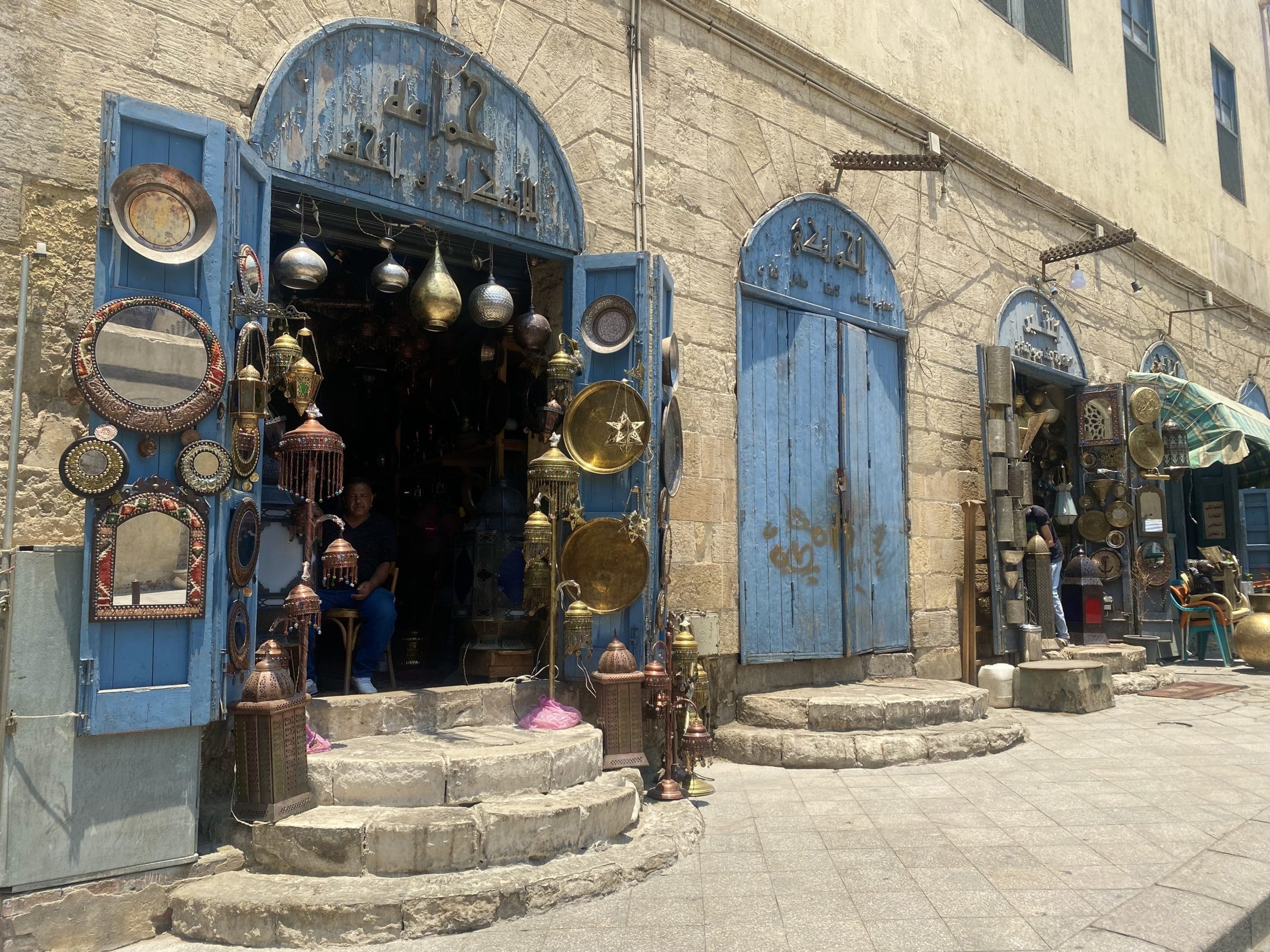
Khan El-Khalili Souk: Built in the 14th century, Khan El-Khalili is a major souk. Popular with tourists, it’s a bit touristic compared to the rest of the area, but still definitely worth a visit.


El-Azhar Mosque: Commissioned by the Fatimid Dynasty in 970, it was one of the first mosques in Cairo, giving it historical significance.
How To Get To Islamic Cairo
Bab al-Futah Gate is about 2.5 miles (4 km) from El-Tahrir Square. If you want to explore on your own, take a taxi to the gate, asking them to wait, or return later. Alternatively, you can arrange a tour of the area or taxi to the Citadel after exploring.


Cairo Citadel
A medieval fort built in the 12th century. It was the center of Egyptian government until the 19th century.


In addition to Muhammed Ali Pashar Mosque, there are also several museums here, including the National Military Museum, Police Museum, and Al-Gawhara Palace Museum.


Behind the Citadel is a stunning view of Cairo.

How To Get To The Cairo Citadel: If you’re coming from Islamic Cairo, the Citadel is about a 25 minute walk southeast of the South Gate, Bab Zuweila, (southern end of Mu’izz street), or short taxi ride. You can also catch a taxi from Islamic Cairo or your hotel.
Coptic Cairo
This area may have been settled by the Persians in the 6th century BC, calling the area Babylon, in reference to the Babylon of Mesopotamia. They built a canal from the Nile (which used to reach here) to the Red Sea.
Later, the Romans built a fortress here, called Babylon, whose ruins remain today.
Before the Islamic conquest in the 7th century, this area was a stronghold for Christianity. In fact, many believe this is where the holy family stayed after their flight to Egypt.
Fortress of Babylon
Built in the time of Roman emperors Trajan to Arcadius (98 AD – 395 AD). Several Coptic churches, a convent, and the Coptic museum sit within the ruins.

Coptic Museum
The Coptic Museum contains the largest collection of of Egyptian Christian artifacts in the world.

Orthodox Churches
Built within, and over, the confines of the Fortress of Babylon, there are several interesting Coptic churches. The church of Saints Sergius and Bacchus is built over the site where Joseph, Mary, and the baby Jesus may have stayed.
Two other well known churches include the Greek Orthodox Church of St. George and El-Muallaqa, the Hanging Church (which got its name as it’s suspended above a passage of the old fortress).


The Hanging Church was the residence of the Coptic Pope after moving from Alexandria in 1047 AD.
Amr Ibn Al Aas Mosque
Just outside Coptic Cairo, is the site of the first and oldest mosque in Africa. Built in 641 AD, after the Arabs conquered Egypt, it was named after the man who introduced Islam here.
I visited on a Friday, which is an Islamic holiday, so the mosque was packed and a market was in full swing in the streets. I bought pita bread, cheese, olives, and cilantro for 5 EGP (about $.25 US cents), and just sat and watched Egyptian life for a while. Almost no one spoke English here, but they were still happy to make a sale.


The girl selling me cilantro (above) wanted to give me much more than I needed for my money, but I let her keep it. She later ran down the street to catch up with me, but due to the language barrier, I never really learned why. I think it was a gesture of thanks for the extra money.
I was very grateful to know how to say thank you (shukran) and peace be upon you in Arabic (As-salamu alaykum).
Getting In & Around Cairo
Cairo is big, so getting around can be challenging. I stayed in a hostel a few blocks from Tahrir Square, where many hotels and hostels are, as well as in Giza.
Bus
Upon arrival, you can take a bus from the airport to downtown Cairo. Ask for the free shuttle bus that takes you to the bus station. There are several buses there that go downtown. From there you can walk or take a taxi.
Shuttle Bus
You can arrange the shuttle bus from the airport to various locations, in advance, here.
Taxi
There are several types of taxis, old ones with no meters, newer ones with meters, and, thankfully, Uber and Careem. To prepare for the ‘no meter’ taxis, ask a cost estimate at your hotel or a local in advance and negotiate before getting in. Or check the Uber cost and use that to negotiate. Remember that those with meters may simply take a longer route, so meter alone does not mean the best deal. Always bring smaller notes as few will have change, or admit to it.
Metro
Some guidebooks suggest not riding the metro in Egypt, but I found it an interesting place to learn about the culture. It’s inexpensive and faster than a taxi, but can also be an adventure. Be prepared with a photo of the map and a plan. Note that Egyptians do not queue, so you need to be assertive when buying your ticket during rush hour, as well as getting on and off the metro.
There are separate cars for men and women, with the women’s cars usually the middle two. Done to protect women from sexual harassment, it’s OK for women to ride in the men’s cars, just not the other way around. I rode solo in the male cars a few times with no issues. During rush hour, when the metro is the busiest, it’s best for females to ride in the women’s cars.
Driving
Don’t try to drive on your own in Cairo. The locals are relentlessly crazy drivers on a free-for-all dash to get around. If you’re adventurous, you can self drive to other cities, but it’s better not to.
Summary
Cairo really is a bucket-list worthy attraction. And if you have time there are so many sites and things to do beyond the main attraction of Pyramids and Great Sphinx of Giza.
To read more of Egypt, also check out my posts on the Pyramids, Luxor, Aswan, Abu Simbel, and Alexandria. And to help you plan your trip, see my Egypt Travel Guide.
If you’ve visited and have comments, or even if you have questions, please drop me a note below.
Note: Egypt has a history of terrorism, so always check government warnings in your country before planning a visit. If you’re a US citizen, sign up for the STEP program. It will send you alerts if issues arise. If you’re not a US citizen, see if your country offers something similar.

Julie
Hello! I resigned from a corporate career in product development to explore the world. Although my goal was to travel for a year, 8 years later, I’ve been honored to have explored more than 60 gorgeous countries and met some unbelievably amazing people. Our world truly is a beautiful place! Follow me into the gorgeous unknown by subscribing below. You’ll receive details on fabulous destinations, comprehensive travel guides, travel tips and tidbits, and information on travel trends, like experiential, sustainable, and transformational travel. Where is your next gorgeous unknown? Julie


You May Also Like

Best Things To Do In Zanzibar | Tropical Paradise Guide

Top Day Trips From Lisbon and Porto
